Skip to content
Strategic Account Management Association

Strategic Account Management Association

Dedicated to helping strategic account managers and key account managers manage improve relationships with their most important customers

  • HOME
  • MEMBERSHIP
  • EVENTS
  • CERTIFICATION + TRAINING
  • TOOLS
  • RESOURCE LIBRARY
  • ABOUT
  • CONTACT

Category: Strategic account manager skills and competencies

The skills, competencies and behaviors that enable the strategic account manager to successfully develop and sustain mutually profitable, long-term strategic customer relationships.

Strategic account manager skills and competencies, Technology

Back to the Future: F2F selling is returning, but virtual selling is here to stay

Jonathan Hughes, Partner, Vantage Partners, and David Chapnick, Partner, Vantage Partners

Just when customer account teams and salespeople were beginning to grow accustomed to virtual-only sales and account management, a return to (some) face-to-face interactions is on the horizon. Customer-facing teams need to continue to up their virtual game, even as they learn how to optimize a balance of virtual and in-person engagement.

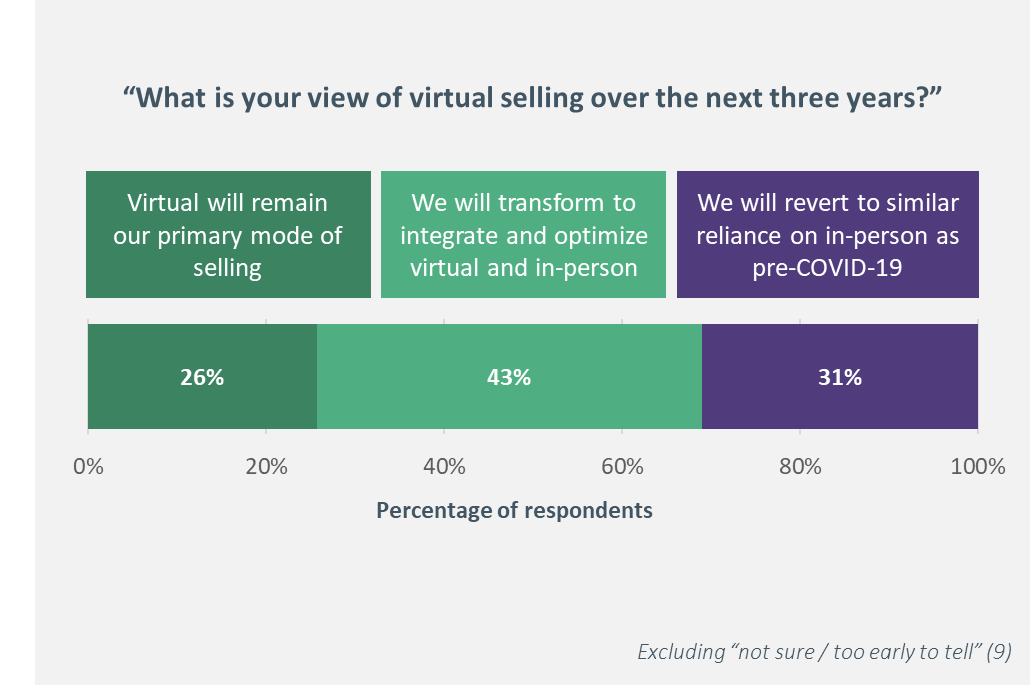
COVID-19 has accelerated a trend already underway toward increased virtual interactions between customers and their suppliers. As vaccines are distributed and we move beyond the most acute phase of the pandemic, most salespeople believe virtual selling is here to stay. According to research we conducted during the second half of 2020 (involving salespeople and sales executives at more than 100 B2B companies), just 31 percent of respondents said they expect to return to pre-pandemic levels of in-person sales activities (Figure1). A strong plurality expects to transition to a hybrid model that optimizes both in-person and virtual selling, while more than one in four expects virtual to become their primary means of interacting with customers.

Figure 1: Percentage of salespeople who expect virtual selling to persist post-COVID
Continue reading “Back to the Future: F2F selling is returning, but virtual selling is here to stay” →
February 2, 2021February 2, 2021Virtual sellingLeave a comment
Strategic account management program organization, Strategic account manager skills and competencies, Technology

Ten insights on the future of SAM

By Nicolas Zimmerman, Editor-in-chief, SAMA

Whether you’re struggling to survive the pandemic or thriving and experiencing unprecedented growth, one thing is clear: We are experiencing radical shifts in how we conduct business with our most strategic customers. As conveners of the largest community in the world dedicated to strategic and key account management, one of SAMA’s foundational purposes is to help our community both adapt to what’s happening right now and prepare for what may happen next.

At the 2020 SAMA Annual Conference (held virtually Nov. 9-11, 2020), we pulled together a group of the smartest, most sophisticated observers, students and practitioners of strategic account management for a conversation on “The Future of SAM.” Highlights are presented below, and the full panel is available on demand by registering for the virtual conference here. 

Moderator: Jim Ford, Chief Commercial Officer, Solecta, and Chairman, SAMA Board of Directors

Panelists: Jennifer Stanley, Partner, McKinsey & Co.; Dino Bertani, Executive Director, International Strategic Account Management,  Allergan Aesthetics; Harvey Dunham, Managing Director, Strategy and Marketing, SAMA; Tom Hablitzel, Senior VP, Enterprise Clients, Sherwin-Williams Company; Jim O’Leary, Global Practice Chair, Corporate Affairs, Edelman

#1. Shifting from focus on shareholder value only to stakeholder value as well – and a broadening understanding of what stakeholder value means.

O’Leary shared takeaways from Edelman’s most recent Business Roundtable, which highlighted the growing emphasis placed on a company’s role in society – from environmental impact to social justice and diversity/inclusion. Non-traditional sources of value will play a growing role in how stakeholders evaluate the impact of companies and their strategic accounts efforts.

#2. Sales and account management – no longer an expense but an investment.

While firms once viewed sales as an expense, in this environment it’s clearly an investment. O’Leary’s advice: Projects with the best “story” will be funded and resourced first. His other advice:

  • Expand whom you interact with at your customers
  • Focus more than ever on active listening. Only by making astute observations will you uncover potential new sources of value.
  • Make sure your internal stakeholders understand the value your program brings to customers and, through them, to the firm. If they don’t grasp it, you may become the target of cost cutting and/or restructuring.

#3. Centralized beats diffused.

When companies shift their programs into the regions or business units, Bertani says, you risk adding inefficiencies, redundancies and opportunities for misalignment. You also risk sacrificing a common strategy, methodology and customer experience.

#4. SAM will become (if it isn’t already) the standard bearer for all sales.

From Stanley’s perspective, SAM already serves as a beacon for what it means to be a sales professional–particularly when it comes to the rigor SAMs bring to account planning, solutions co-creation with customers and articulation of unique value propositions.

#5. Centers of Excellence (CoE).

Bertani says these centralized groups of SAM experts can and should be leveraged as the catalyst for instilling the mindset, skill set and processes for distinctive go-to-market and customer-centric engagement models.

#6. Agility is the new stability.

In disruptive times, leaders need to increase their organizations’ agility by focusing on what really matters and making much faster decisions. Bertani recommends trading perfection for simplicity. “I’d rather be approximately right,” he says, “than exactly wrong.”

#7. Those who have the data, and use it wisely, will control the playing field.

If you’re accumulating data on your customers and even your customers’ customers, how are you using it to develop insights that lead to innovative value propositions? How are you linking it to your core business strategy?

#8. In just a few months, COVID accelerated digital adoption as much as 10 years.

What this means is a vast proliferation of data on customer behavior. Those companies that both control the data and utilize it most effectively to glean customer insights will be the ones who will control the playing field. Stanley predicts that digital adoption will spare SAMs from much of the day-to-day “firefighting” of the job, freeing them to look into all this new data and distill it back into insights about their customers.

#9. The profile of strategic account teams will shift dramatically.

New and different skills will be needed to analyze all this new data and make use of it, leading to teams that include not only data scientists but also behavioral scientists and others with non-traditional sales skills. Teams will also need to become flatter, less hierarchical, in order to move quickly and with agility.

#10. Customers will reward suppliers who successfully blend a great digital experience with the human touch.

When McKinsey surveyed B2B buyers to see whether they prefer to buy digitally or from people, the answer, overwhelmingly, was “it depends.” Turns out customers are much more likely to reward suppliers with sole-source contracts when they excel in both areas and know which channel is right for which kinds of interactions.

Want more? A recording of the discussion, more than two-dozen breakout sessions and keynote presentations is available for unlimited, on-demand purchase. See what you missed here.


December 3, 2020February 1, 2021Digitalization, Future of SAM, Strategic account teamsLeave a comment
Strategic account manager skills and competencies

Five Key Principles for Successful Negotiations

By Kunal Bhatia, Senior Global Account Director, Johnson & Johnson

Over the course of this year we’ve experienced tremendous change. Whether it’s the way we work, the way we socialize or the way we get around, the COVID-19 crisis has fundamentally changed pretty much everything. Having shifted mostly to the virtual arena, negotiation is no exception.

As both a global account director AND the parent of young children, I can’t overstate the importance of negotiation skill. Whether it is negotiating a multimillion-dollar contract, compensation particulars with a potential employer or appropriate screen time with your children, strong negotiating acumen is critical for survival.

While virtual negotiations might be perceived as time and cost efficient, if they’re not done right they can hinder social awareness, social interaction and cooperation. Having worked in different countries, cultures and roles, I’m cognizant that myriad nuances must be taken into consideration to promote smoother, less contentions negotiations. However, I have observed that the need to be a skilled negotiator is agnostic of culture, industry, profession and job level and that certain negotiating principles are near universal.

Here are my top five.

#1: Make the first offer. There is a widespread belief that it is wise and strategic to let the other person make the first offer. However, there is virtually no research that supports this claim. In fact, research shows a strong and powerful positive effect of making the first offer.

Admittedly, it does takes courage to make an offer, especially in situations of ambiguity or when you’re in a low-power position. However, first offers have a strong anchoring effect, which exert a strong pull throughout the rest of a negotiation. Even when people know that a particular anchor should not influence their judgments, they are often incapable of resisting its influence. As a result, they insufficiently adjust their counter-offer away from the anchor.

#2: Focus on differences. Conventional wisdom says that we negotiate to overcome the differences that divide us, so we look for win-win agreements by searching for common ground. Common ground is generally a good thing, yet some of the most overlooked sources of value arise from “differences” among the parties. 

Differences of interest, priority or hierarchy-of-needs can open the door to unbundling different negotiation elements, leading to outcomes that potentially give each party what it values the most, possibly at the least cost to the other. 

#3: Zoom-in on interests, not just issues. Three elements are at generally play in a negotiation:

• Issues: on the table for explicit agreement

• Positions: where each party stands on the issues

• Interests: each party’s underlying concerns. 

Don’t just negotiate the issues. Great negotiators understand that the dance of opposing positions is only the surface game, and they focus instead on probing behind their counterpart’s positions to identify their full set of interests at stake. Before any negotiation begins, seek to understand the interests and positions of the other side, and weigh/measure them against your own interests and positions. 

#4: Listen. There’s a widely held assumption in the business world that negotiation is mostly about talking and that the best negotiators are the best conversationalists. That view overlooks perhaps the most crucial aspect of the negotiation process: listening. In the words of de Callières, “one of the most necessary qualities in a good negotiator is to be an apt listener.” Your attention should be focused on the words and actions of the other side, your own words and actions, and the effect of your words and actions on the other side.

#5: Help your counterpart sell. The person on the other side of the table might agree that your offer is reasonable, but they will still reject it if they can’t sell it to others in their organization. Your job as a negotiator is not simply to convince the person with whom you’re negotiating but also to help them be an effective ambassador for you when they speak to their boss, their board, their partners or others who have a stake in the outcome. Keep an eye on all of the people who can influence the negotiation on their side and help craft a narrative that will allow your counterpart to get the buy-in he or she needs.

Final thoughts

These are some key principles that have helped me negotiate large and complex contracts at work and also keep the peace with my young children at home. One bonus tip from personal experience: To be a good negotiator, you must practice patience.

Patience is difficult, especially when you have a deal that is constrained by a time limit imposed by a leader or a contract expiry. But if you’re impatient or time constrained by a deal that isn’t moving fast enough, you may make unnecessary concessions in order to get it over the finish line. This can have long-term consequences.

It can also be counterproductive, as the other side may be less satisfied with a concession made easily in quickly, as they will perceive it as being of low value. Practicing patience, whether with your customer’s Procurement team or with your children, encourages flexibility and provides time for the other side to accept otherwise-tough choices.

Further reading:

“6 Habits of Merely Effective Negotiators”

“Should you Make the First Offer?”

“The Art of Deal Diplomacy”

“Five Reasons Good Deals get Rejected”

“Investigative Negotiation“

Kunal Bhatia is senior global account director at Johnson & Johnson, where he has worked for 16 years in a variety of sales, marketing and leadership roles. Connect with him on LinkedIn.

August 18, 2020August 17, 2020NegotiationLeave a comment

Posts navigation

Older posts
Newer posts

Recent Posts

  • Velocity Magazine Winter Issue 2025: Building Trust and Driving Innovation

    January 23, 2025
  • Revolutionize Customer Conversations with AI

    January 10, 2025
  • AI Tools to Supercharge Your Sales Strategy

    January 9, 2025
  • Collaborative Ecosystem

    December 9, 2024
  • How SAMA’s Customer Advisory Board Influences Best Practices in SAM

    September 27, 2024

Social

  • View SAMAtweet’s profile on Twitter
  • LinkedIn

Subscribe to Blog via Email

Enter your email address to subscribe to this blog and receive notifications of new posts by email.

Powered by WordPress.com.
Strategic Account Management Association
Contact / Proudly powered by WordPress Theme: Shoreditch.
Loading Comments...