Dedicated to helping strategic account managers and key account managers manage improve relationships with their most important customers
Category: Strategic account manager skills and competencies
The skills, competencies and behaviors that enable the strategic account manager to successfully develop and sustain mutually profitable, long-term strategic customer relationships.
By Neil Tumber, Relationship Manager, Advanced Services Group
Just like data, automation, Industry 4.0 and the Internet of Things (IoT), servitization has become something of a buzzword – and for good reason. Servitization and advanced services offer the potential for organizations to significantly transform their business models to deliver even greater value to customers while also increasing their own profitability. But what do we mean by servitization, and what exactly are advanced services?
In this post, we will explain everything you need to know.
What is servitization?
Servitization is a term used to describe a journey of transformation, specifically: the innovation of an organization’s capabilities and processes to better create mutual value through a shift from selling products to selling product-service systems that deliver a desirable outcome for the customer. So, for example, instead of manufacturing and selling a machine tool and ending the transactional customer relationship there, a business instead might produce and sell the machine tool as part of delivering a contracted support and maintenance service.
Servitization: a practical example
An example of servitization is Koolmill, a business in the UK that works with the Advanced Services Group at Aston Business School. Like several manufacturers, Koolmill was originally set up to produce and sell machines – in Koolmill’s case, rice-milling machines. However, much of its customer base is in low-income regions of countries such as China and India, where the price associated with milling-machine ownership is considered prohibitively expensive. To overcome this challenge, the business transitioned to a servitized approach, offering rice-milling-as-a-service.
By Jacques Sciammas, President, Selling to Executives
In the age of convenience, where same-day deliveries have become the gold standard and news articles are now conveniently timed down to the second, our need for accurate and concise information has never been more pressing. So why on earth do we still bother with documents numbering hundreds of pages, sans picture and color? Truth be told, 99 percent of us don’t bother reading these documents at all. They make great paperweights, but if asked about specific details, most of us might offer an uneasy grin, knowing that we have companions-in-arms, equally guilty of shirking that responsibility to read altogether.
The 10-K report: Why bother?
You’re familiar with a company’s annual report, right? But very few bother with the 10-K. And for those of you who have heard of it, do you really understand its value? Unfortunately, due to its no-color, no-graphics (thereby implying “no fun”) standard format, a format mandated by the Securities and Exchange Commission, the 10-K is easily the most overlooked, undervalued and – shockingly – untouched research document.
In my personal experience as CFO for several large corporations, where I chaired the Capital Committee (i.e., the committee responsible for overseeing purchasing decisions), I met thousands of salespeople and strategic account managers through the years, and I would say that no more than 3 percent or so had bothered going through my company’s 10-K. Now, those familiar with the 10-K may be groaning out loud and thinking, “Who is going to actually read that monstrosity?!!” And it’s true. It would be similar to “indulging” in the U.S. tax code, a document filled to the brim with dense terminology and one-dimensional creativity.
“Stop Jacques! The 10-K is tedious. I’ d never get through it, despite my and your good intentions!”
Fair enough, but let me put forth the good news [Drumroll, please!]: One doesn’t need to go through the entire document to gather the most crucial nuggets of information. While it’s true that the top executives and their legal teams are involved in the creation of the 10-K, what makes this document vital to SAMs and GAMs are the highlights (and confessions) stealthily included – and typically ignored. These highlights can assist SAMs and GAMs enterprising enough to sleuth them out to establish strong credibility and relevance with the C-level and to truly differentiate themselves from their competitors.
By Arun Sharma, Professor, Marketing, Miami Herbert Business School, University of Miami
Arun Sharma willdeliver a keynote address at the 2021 SAMA Annual Conference (May 24-26). To learn more, or to register, visit the conference website.
Resilience is an organization’s ability to withstand a major disruption, recover quickly and adapt to the changing environment. During the COVID-19 pandemic, some firms have flourished while others in the same industry have floundered. To give a couple of examples: Among department stores, Nordstrom has demonstrated resilience by dramatically increasing online sales; as a result, they have excelled. Arch competitor Neiman Marcus, on the other hand, has declared bankruptcy. In telecommunications, while most firms have posted strong results, Digicel has declared bankruptcy. Researchers who have studied this topic have found that having flexible resources (monetary, assets-based and human), flexibility and adaptability increase organizational resilience.
Classifying organizations
To better understand why some organizations exhibit resilience while others do not, we conducted interviews with senior executives, analyzed industry and firm performance, and examined extant academic research on organizational structure, resilience and liquidity. Liquid organizations develop and execute strategies faster than their competitors, they change direction and accelerate rapidly, and they are ambidextrous – by which we mean they can simultaneously leverage their existing competencies (“exploitation”) while at the same time they discover and harness new opportunities (“exploration”).
The first thing we did was to classify the organizations, at which point four distinct organizational categories emerged:
Hierarchical. In hierarchical organizations, every employee reports to one and only one supervisor (except for the CEO). This is the classic, pyramid-shaped organizational hierarchy. Most government entities, and many corporations, follow this organizational form. It is typified by slow and deliberate decision making, a decision-making process that is rigorously codified and decision making authority that is rigidly prescribed.
Matrixed. Matrix organizations are designed to increase teamwork between internal-facing (e.g., marketing, R&D, finance) and external-facing departments (geographic and product market). Most employees have dual responsibilities: to the function to which they belong (e.g., marketing) and the market in which they operate (e.g., Latin America). A matrix organization is typically visualized as a rectangle with internal functions (horizontal lines) and markets (vertical lines) forming the structure. Most modern organizations follow a matrix structure. Unfortunately, the amount of teamwork expected in matrix structures has not materialized, and rather than focusing on making the best possible decisions, negotiated decision making is the norm.
Entrepreneurial. Entrepreneurial organizations are unstructured, where both functional roles and reporting structures are flexible and adaptable to the context. Employees typically perform multiple functional roles, and decision making is decentralized and team-based. Due to the lack of structure, these firms are typically small and have fewer employees. Decision making is quick, and the organization is adaptable. However, scale and growth require organized decision making, and most entrepreneurial organizations shift towards matrix or hierarchical organizations as they grow.
Liquid. Liquid organizations use team-based structures to increase the quality, speed and innovativeness of outcomes. They focus on skilling their employees in multiple functional areas and create organizational relationships to become more flexible and adaptable. Liquid organizations combine the speed and flexibility of entrepreneurial organizations with the scale of global organizations.
Resiliency of organizations
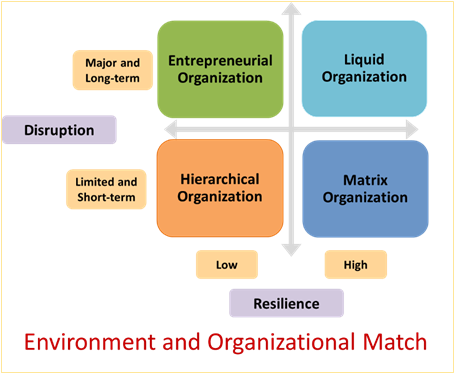
Our second project involved examining the context under which each organizational form would be most successful. In analyzing our data, we identified two dimensions that affected organizational success: the degree of disruption and resilience. Then we moved on to identify the context under which each type of organization would be most prone to success.
We found that hierarchical organizations are only successful when there is a limited need for resilience, and disruptions are limited and short term. That is because hierarchical firms are slow to recognize disruption and tend to be deliberate (i.e., slow) in making decisions.
By contrast, matrix organizations tend to be more resilient and able to make decisions more quickly – but only when disruption is limited. This is because the matrix organization’s complex structure makes rapid strategic and tactical decision making very difficult. For this reason, matrix organizations are best suited to times that require high degrees of resilience, but only if disruption is limited and short term. Extensive academic research shows that matrix organizations function favors stable environments but falter when conditions are prone to changing rapidly.
Entrepreneurial organizations are flexible, which equips them for addressing major and long-term disruption; but they struggle to exhibit resilience because they do not have the resources (monetary, assets-based and human) to sustain them during long-term disruptions.
Finally, our research found that liquid organizations are best suited to thrive when resilience and adaptability are most in demand. Liquid organizations are both resilient (thanks to their scale) and possess the ability to sustain and grow through major disruptions due to organizational speed, flexibility and adaptability. In our research on the impact of COVID-19, we find that the most successful and resilient firms have been those that are the most liquid.
Our Recommendations: Liquidity and you
To increase resilience, we recommend that leaders take steps to increase organizational liquidity.
Specifically, we recommend they take three steps:
Create and use teams to increase liquidity and quality of deliverables. We suggest that executives form teams by pairing people from different vertical markets or functional areas. (For more on creating teams within the strategic account management program, see “Addressing the New Normal: Creating Liquid Strategic Account Teams,” in the Fall 2020 issue of this magazine.)
Increase the multifunctional expertise of executives through training and assignment.
Reduce boundaries between the firm and suppliers by creating teams that include people from both firms.
In summary, our results suggest that leaders need to focus on increasing resilience by increasing liquidity. While the emergence of multiple highly effective vaccines portends an end to this global recession, it surely won’t be the last time organizations face conditions requiring high resilience levels.
Arun Sharma is a marketing professor at the University of Miami’s Herbert School of Business, has published extensively on strategic accounts, and is ranked in the top 1% of all marketing professors. Find him online at https://www.theliquidorganization.com/.