What suppliers can do mid-contract to future-proof their negotiations

By Jeff Cochran, Partner, Shapiro Negotiations Institute

We’ve all been there before. You’re halfway through your initial contract with a new client. Things are going great. Sure, there were some growing pains in the beginning, but you feel you and your firm are adding a lot of value and you’re confident your client feels the same way.

So why is it that most of us always wait until the current contract cycle is about to wind down to engage about an extension?

At Shapiro Negotiations Institute, we coach the principle that the best negotiation occurs when you have leverage. This article discusses what you, as a supplier, can do mid-contract to make your upcoming negotiations more successful.

Step 1: Get your team on the same page

One common challenge for renewing or upselling business at the point of a contract extension is simple: alignment. Typically, coordination among departments and team members is never as tight as it is during the initial pitch exercises for that first deal. Once the work is won, however, the contract begins to take on a life of its own. This can become a challenge down the road when it’s time to re-negotiate.

In some cases, we’ve seen companies do a complete “hand-off” at various stages of the project. From winning the deal to kicking off, or from moving a project into a new stage of development, suppliers can become distanced from the actual work and, therefore, from the relationship with the customer. This is usually where an oversight role — like that of a strategic account manager, who’s responsible for the overall corporate relationship with the customer — can be helpful to coordinate everything from start to finish.

Even in working relationships that involve a SAM at some level, it is still critical to keep the team aligned. Especially in larger projects, we commonly see senior partners or directors forming the arrangements but more junior associates or managers doing the day-to-day work. Over the life of the contract, this sometimes results in providing extra services at cost for the good of the relationship or the “leaking” of various intel from your team to the clients. 

In any case, we recommend having consistent communications and team check-ins at multiple stages through the life cycle of the project. Establish priorities, discuss future opportunities and even determine talking points around critical internal issues. A united front is imperative to successful (and smooth) renegotiations and extensions. 

Step 2: Manage expectations

Negotiations are about promises and clear terms to create a value exchange. Misunderstandings can be catastrophic. Therefore, you should manage your client’s expectations at all times. We’ve coined this essential tenet “Cochran’s Law” after – you guessed it – Yours Truly. 

Cochran’s Law boils down to the idea that satisfaction = reality ÷ expectations. If expectations rise, then reality – what your client receives from you — has to rise as well if you want to keep them satisfied. If you provide too little, you put your contract renewal or upsell in jeopardy. But if you provide too much, you spoil them for the next agreement and risk a drop in customer satisfaction.

There are a number of ways to manage expectations throughout the negotiation and project, but two of the simplest will never fail:

  1. Work to understand the client’s decision-making process. Do what you need in order to understand which stakeholders are involved, who has final approval and what key performance indicators will determine success. Connect lofty business goals to concrete and measurable objectives so you can align on exact targets. 
  2. Build relationships along the way. Most discovery processes will allow you to create a map or schematic of the key stakeholders, their roles and what they value most. Whenever possible, we recommend building relationships with as many of these stakeholders as possible, leveraging the reach of your full team. Going deeper into key departments will help you gather more intel, while going wider into other departments may offer you different perspectives or insights about the project and its value to the company. Maintaining only one key contact leaves you at risk if they change roles or leave the organization. 

The key is to get credit for the extra value you provide and manage expectations on what you’re expected to deliver. Once you know the client(s) and what they value, you can maintain status quo or scale your value strategically to surprise and delight. For example, small tasks like setting up Google alerts to help your client track media mentions and performance could be highly valuable to your client with minimal extra effort on your part. 

Step 3: Always be selling

Your mindset is key. A trick of the trade – something you’ve probably heard a ton and possibly even scoffed at – is that you need to always be selling. Remember: While you’re delivering your work and building your relationship, you’re also always in a constant cycle of negotiation.

Your work product is part of that negotiation. The rapport you build personally and professionally factors into it, too. Another common mistake we see is people referring to the time before your contract expires as “the renewal cycle.” Many companies fall into this trap of “OK, we’re about one month away from our deal expiring, it’s time to start negotiating again.” If you begin your negotiation weeks before your current deal expires, you’re already on the back foot.

The effort you put in in the middle of the agreement is actually often the most valuable for several reasons:

  1. Your client will feel like you are really invested in him or her, rather than just appearing to care when it is time to renew. High-quality partnership will be remembered.
  2. Projects and work streams don’t always follow fiscal cycles. Effective work mid-project will lay foundations for your team that may actually make it more challenging to end the contract than to extend it.
  3. Strategic planning should never be limited to one window. Throughout the project, every task should ideally serve a larger purpose in a strategic plan looking at least three years out. Helping your clients identify long-term priorities both allows you to shape them and gives you a seat at the table as their foundational partner. 
Your Next Contract Negotiation

Be prepared, be engaged and be committed. Those three traits will go a long way in your continued success.

Jeff is a partner at Shapiro Negotiations Institute and a frequent presenter and keynoter for Strategic Account Management Association. Connect with him on LinkedIn: https://www.linkedin.com/in/jeffcochran/
Got CXM? Why customer experience management isn’t just a nice-to-have for strategic account management

By Raj Parekh, Partner, CuebridgeCX

According to Gartner, it’s the “new competitive battlefield.” Per Forrester, 84 percent of firms aspire to be leaders. In strategic account management, companies have to address the never-ending question of how to differentiate themselves and gain market share. And yet most SAM organizations — large and small — haven’t tapped this potentially huge source of competitive differentiation.

I’m talking about customer experience management (CXM), which I would argue may be the single most important investment a company can make in today’s cut-throat business climate. It is absolutely essential to success today.

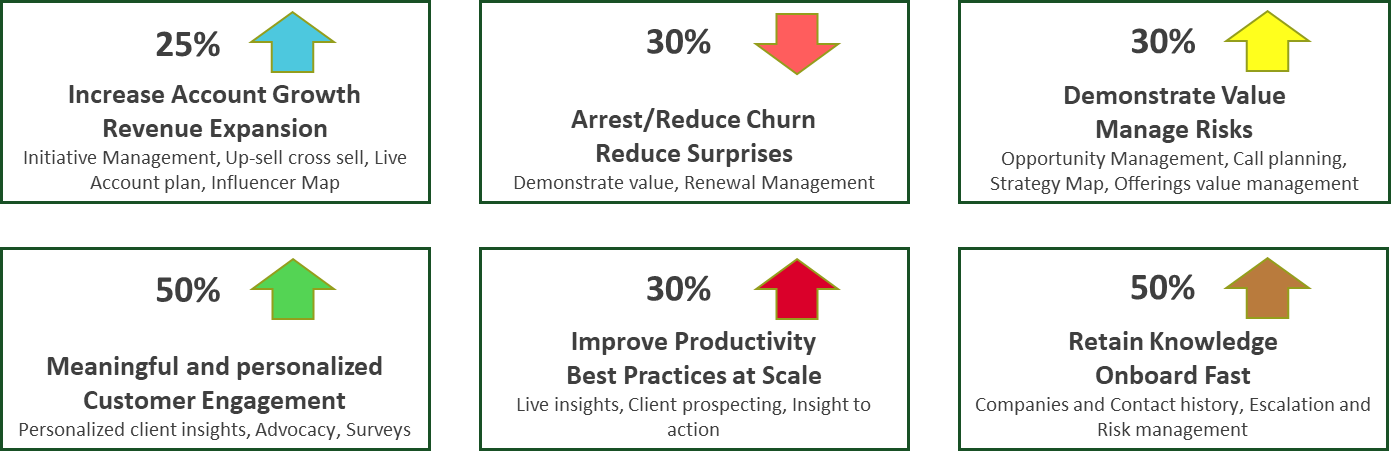
Leading industry publications and consulting companies have conducted significant research into the growing trend and have found that:

CXM vs. CRM: Do you need both? 

Yes! (And here’s why.)

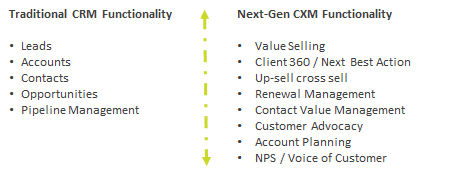
The reasons lie in how these systems are built and the purposes they are built to fulfill. CRM systems are focused on opportunity management, while CXM systems are focused on managing the ongoing delivery of value and the assessment of outcome attainment. CRM tools are not designed to manage triggered work streams or focus on sustaining and protecting ongoing revenue and client relationships – all activities that are fundamental to the successful implementation of a strategic accounts approach. This is where CXM shines.

First, a definition of terms:

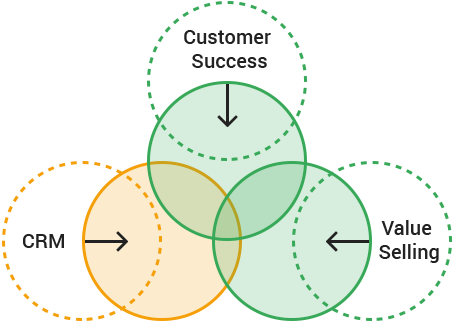
CRM CRM software keeps sales processes organized and aligned with best practices up to the point that a deal is closed.

Value Selling A sales approach that focuses on benefiting the customer throughout the life cycle of your relationship. Account managers are focused on taking a consultative approach to selling, such that customer decisions are based on the overall value potential of the supplier’s products and services.

Customer Success Once a deal has closed, customer success continues the relationship by helping to deliver on the promises made during the sales process. Customer success is focused on retention, loyalty and advocacy.

Add them all together, and you get customer experience management. Bottom line: You need both CRM and CXM for your business to succeed. 

https://cuebridgecx.com/images/CRM-chart.png

The basics: What CXM actually is

Does introducing CXM mean implementing a completely separate system from my existing CRM? In a word: No! Customer experience management is complementary to your CRM. When done right, CXM helps optimize your overall technology investment by laying customer experience functionality on top of your existing CRM. How? By bringing the power of digital transformation to your customer relationship through enabling your strategic account managers to provide superior insights and experience to their customers at every stage in their journey with your company’s products and services. 

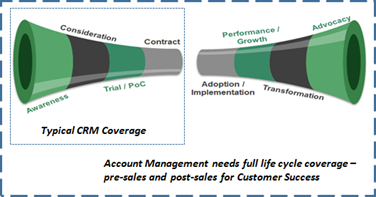
The Customer Life Cycle: From Awareness to Advocacy

Advantages and key design elements of CXM system

With the introduction of digital natives among client organizations, CXM has emerged as the next frontier for account teams. For companies to survive and thrive, cultivating and focusing on growing existing customer relationships has become integral to strategic planning and operational execution.

The implementation of CXM is the ultimate solution.

Traditional CRMNext-Gen CXM
Unified System
Key accounts data and essential intelligence is spread across the organization (financials in external systems, plans in PowerPoint, Excel and Contacts & Opportunities in CRM, Google search, et al.)Under one Unified application, CXM combines data silos and digitizes functions by leveraging CRM, social media, and financial and contract data to deliver a superior client experience across their life cycle with your company.
Insights to Action
No standardized way for management to trigger best practices and required field actions in real time
CXM system triggers workflows on real-time basis for account teams to take time-critical action to service clients effectively, stay ahead of the competition and be consultative
Best Practices at Scale
Best practices are often not standardized across the organization. Disparate approaches rule the roost.
CXM systems are designed to coach users and allow critical thinking at the point of client engagement. It provides periodic updates and expert guidance to users for effectively performing their day-to-day tasks 
Enterprise Memory
Account intelligence is tacit and ad hoc. Risk of data loss due to employee attrition negatively impacts future growth.CXM system maintains enterprise memory by combining data like Client 360, activities, engagements, etc.
Employee (User) Experience
CRM adoption among employees/users is challenging. Account teams often wonder, “What’s in it for me?” While CRM provides visibility to leadership, it struggles to provide value for the actual users, i.e., the account managers.Successful CXM systems are designed to add value, simplify day-to-day task management, reduce tedious data entry and create essential utility for the account teams. For leadership, they provide visibility into account team activities and productivity.
Benchmark outcomes achieved by successful  implementation of CXM
CXM: Meet Your Customers’ Needs

Your customers deserve the best service. By combining CRM with CXM, your business will increase revenue, garner and retain new customers, increase credibility with existing customers and create lasting trust with your long-term relationships.

CuebridgeCX LLC, specializes in key account management and client engagement technology. CuebridgeCX offers out-of-the-box customer experience management (CXM) solutions and value-based go-to-market services. www.cuebridgecx.com

“Extreme” Negotiations with Customers

By Jonathan Hughes, Partner, Vantage Partners; Ben Siddall, Partner, Vantage Partners; and David Chapnick, Principal, Vantage Partners

In November 2010, Jonathan Hughes, Aram Donigian, and Jeff Weiss published an article in the Harvard Business Review titled “Extreme Negotiations” that highlighted lessons in effective negotiation under extreme pressure from the U.S. military that also apply in the business world. Today we revisit those lessons in a very different world. The COVID-19 pandemic has shaken world markets, created significant political and financial instability, and reduced business predictability. Many companies have experienced a slowdown in business activity, with resulting revenue losses over the past several months.

As the news changes every day, timeframes for recovery are uncertain and will vary significantly by industry sector. As we saw in the 2009 financial crisis and subsequent recession, challenging contract renegotiations are a predictable result of this new reality. As companies in many industries confront shrinking demand, higher levels of unused inventory and increased uncertainty, they will undoubtedly turn to suppliers for cost savings while simultaneously looking for guarantees of supply assurance.

Sales teams will need to respond to heightened pressure from customers to reduce pricing, while negotiating to protect revenue and margins — even as they work collaboratively with customers to meet their needs and address their constraints. The current environment thus raises the stakes in customer negotiations and also increases the risk that negotiations become adversarial.

A key insight underlying the ideas in the 2010 HBR article is that negotiation behaviors tend to be deeply ingrained and are often reactive rather than deliberate, especially in high-stakes and stressful situations. Today’s environment can be viewed through the same lens. These strategies are not only useful at the bargaining table but can (and should) also serve to reshape planning and positioning far in advance of formal negotiations that we know are coming. A strong (collaborative) offense is the best defense.

Editor’s note: This article has been edited for length. The full piece, featuring multiple customer examples, will appear in the Fall issue of Velocity magazine.

Strategy 1: Broaden your field of vision, question assumptions, and rethink objectives

Start by identifying key assumptions and subject them to scrutiny; use negotiation planning and execution to continually gather new information and revise strategies accordingly.

One hallmark of the “extreme” negotiation is a feeling of danger creating pressure to act fast to reduce the level of perceived threat. In the face of this pressure, negotiators often begin acting before they fully assess the situation. They act and react based on gut feel and initial perceptions. Given the added pressure to look strong and gain (or remain in) control, they tend not to test or revisit their initial assumptions even as the negotiation progresses. As a result, they often negotiate based on incomplete or incorrect information. This often leads to conflict, impasse, or, at best, a resolution that addresses only a part of the problem or opportunity at hand.

Continue reading ““Extreme” Negotiations with Customers”