

Harness the power of AI to prepare for meaningful, results-driven customer interactions.
Dan Adams, President, The AIM Institute
In a previous post, I discussed how AI tools can supercharge your sales strategy. One of the best areas to apply these tools are when sales professionals like you prepare for customer interactions, which can open doors to deeper, more meaningful conversations. Research shows utilizing AI to prep for customer visits not only delivers a huge impact on sales success but also represents a significant area for improvement among many sales teams. Below, we’ll explore how AI can elevate preparation strategies, driving richer, more productive dialogues that foster stronger relationships and better outcomes.
Imagine the following takes place on your next visit to a strategic account:
- While waiting in the customer’s lobby, you do a final check for any late-breaking news about this company.
- You begin by asking your contact if their new acquisition will affect her work in any way. Your contact is clearly impressed you’re aware of this acquisition.
- Your contact mentions a project she’s struggling with, and you ask intelligent, empathetic questions. She feels truly “listened to.”
- Your contact goes deeper into technical details. At first, she’s hesitant to do so, but soon realizes you understand all their specialized terminology.
- She mentions an obscure process step and is surprised you thoroughly understand this too. Clearly, you’ve done your homework.
- Near the end of the conversation, you recap two problems you’ve heard that she needs help addressing. She confirms you’ve “nailed it.”
- You suggest next steps and she eagerly agrees. As you leave, she thinks, “Now there’s a sales professional I’ve got time for!”
What just happened? And how did AI help? To have the conversation described above, the strategic account manager was prepared. Sadly, many are not.
According to Forrester Research, 75% of B2B executive buyers say salespeople are not knowledgeable about their business, and do not understand the issues they face. It’s not surprising then that only one in four salespeople get an agreement from these buyers to meet again.
Let’s see how the clever use of AI can change this. This sales call preparation takes two forms:
- Insights: When a sales professional has gathered high-quality, pre-call information about the customer and their issues, they are welcomed into a deep conversation about how they might help that customer.
- Skills: When a salesperson has mastered probing skills to ask the right questions, they sell more. Why? Because they learn which products to pitch, which customer pain points to address, and they demonstrate they are interested in the customer.
Turns out you need both types of sales call preparation. Pre-call insights alone don’t go deep enough. This information won’t tell you what your customer contact is wrestling with today. You’ll need to skillfully ask questions “on the fly” to learn that.
And if you show up unprepared and ignorant — even with great probing skills — it’s unlikely your customer contact will have much time for you. Let’s see how AI can support both forms of sales call preparation, beginning with insights.
AI to gather pre-call insights
Imagine you’re a salesperson preparing to call on an existing B2B customer. What will you spend most of your time talking about… your product or their world? It’s sad but true: Customers don’t care about your product. They simply “hire” your product to accomplish their “job to be done” (aka, their application or task).
In a study of nearly 24,000 sales conversations — all of which were consultative in nature — the top performers talked about their product features only half as much as the less successful salespeople.
Of course you want to be a top performer, but what “customer world” information should you gather ahead of your meeting? Your sales call preparation should include five items:
- Business status: You’ll need a refresher on all aspects of your current business dealings with this customer, e.g. orders, pricing, commitments made during your last call, etc. When you have this information at your fingertips, you establish yourself as a credible professional.
- Company news: You don’t want to be surprised by their new acquisition, divestiture, vice-president, or company announcement. And this background can give you great “icebreakers” to start your meeting: “Are you personally impacted by your company’s new acquisition?”
- Market trends: You’ll be able to engage your customer more deeply if you’re familiar with current trends their specific industry is facing: “I’ve been reading about this trend, and I wanted to get your opinion on it.”
- Common problems: When you gather the top 15-20 problems faced by companies in your customer’s type of business, it helps in two ways: 1) If your customer brings up one of these problems, you’ll be prepared to discuss it, and 2) you can ask them if they are dealing with some of these issues.
- Process steps: The final item for sales call preparation is becoming familiar with the steps your customer goes through when using your type of offering. This lets you explore steps you could help them to accomplish faster, better or cheaper.
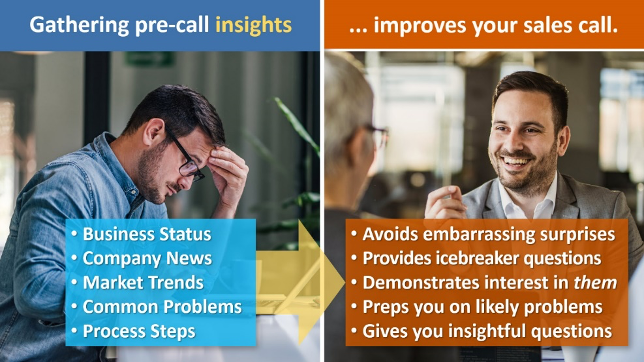
With these insights in hand, you’ll go into your customer meeting with confidence. You won’t get blindsided by important news you should have known about this company. You can “break the ice” at the beginning of the meeting by asking about their recent acquisition or new president. This is much better than… “I was passing through town and thought I’d stop by.”
For the first of the five items listed above (Business Status), you’ll need to rely on your existing CRM (customer relationship management) system, which likely has AI built into it.
But the remaining four items can be delivered using AI prompts in ChatGPT or a similar AI engine. The last AI tool cited (www.SalesPrep.com) in the previous blog post captures all this information when you enter three items:
- The company you’ll call on (e.g. Caterpillar)
- Your type of offering (e.g. hydraulic cylinders)
- The customer’s job-to-be-done (e.g. manufacturing backhoes)
Within 60 seconds, a full report — with company news, market trends, common problems, process steps, and company overview — is produced on your phone or desktop computer. (Disclaimer: SalesPrep is an AI tool developed by the author and his team.)
AI to ask the right questions
Sales professionals who ask the right questions sell more. The evidence is compelling:
- In the research behind the landmark book, “Spin Selling,” 35,000 sales calls were monitored. They found the most successful sellers asked questions about the customer’s situation, problems, implications, and needs/payoff.
- Sales Insights Lab analyzed 23,900 sales conversations and learned that top performers asked 39% more questions than the average salesperson.
- At The AIM Institute, we surveyed nearly 400 B2B salespeople on 12 voice-of-customer skills and found a strong correlation between probing skills and selling success.
But what are these “right” questions? And how could AI help you develop the right ones? I recommend you read chapters 32-to-34 of “The AI Edge: Sales strategies for unleashing the power of AI to save time, sell more, and crush the competition,” by Jeb Blount and Anthony Iannarino. You’ll find many AI prompts you can use to generate good “exploratory” questions.
But you also need to be skillful in asking “probing” questions on the fly. Once you’ve uncovered a customer problem with exploratory questions, probing questions help you understand the problem in great depth. These questions accomplish three objectives:
- You learn which of your offerings to recommend later.
- Since you understand their pain points, you know which benefits to promote.
- You signal a sincere interest in the customer and your desire to help them.

- Velocity Magazine Winter Issue 2025: Building Trust and Driving Innovation - January 23, 2025
- Revolutionize Customer Conversations with AI - January 10, 2025
- AI Tools to Supercharge Your Sales Strategy - January 9, 2025