

By Phil Styrlund and James Robertson
In the first two posts of this series, we discussed how larger business forces are pushing companies to rethink how they work with their customers, and how the most advanced companies are responding by systematically plumbing their customers for insights they can use to jointly create new sources of business value. In this post, we move on to the fun part: creating joint solutions, driving execution and communicating the value.

Create joint solutions
In this crucial phase, the company and customer:
- Agree on and apply an approach to creating joint solutions that leverage the enterprise resources, capabilities, enablers and strengths of each organization
- Collaboratively engage in structured ideation and brainstorming to identify “beyond-the-product/-service” enablers and generate potential solutions
- Screen solutions and enablers for inclusion, exclusion or further development considering their relevance, impact and feasibility
- Align, engage, and commit relevant resources to develop the prioritized solution(s)
- Value engineer to optimize the solution for impact and differentiation considering solution components and enablers that can be added, eliminated, elevated or reduced
- Prototype and test the solution with emphasis on agile development — testing early and failing fast, at the lowest cost
At the outcome of this phase, both organizations have co-created a joint solution relevant to the prioritized opportunity and have agreed to move ahead to build and validate the business case, communicate compelling value and to pilot and then implement the solution, joint initiative or new business model.
Our proposed approach for creating joint solutions starts with a prioritized customer “CareAbout,” aligns relevant products and services, and integrates enterprise capabilities beyond the core product/service that impact what the customer and/or end-user cares about most.

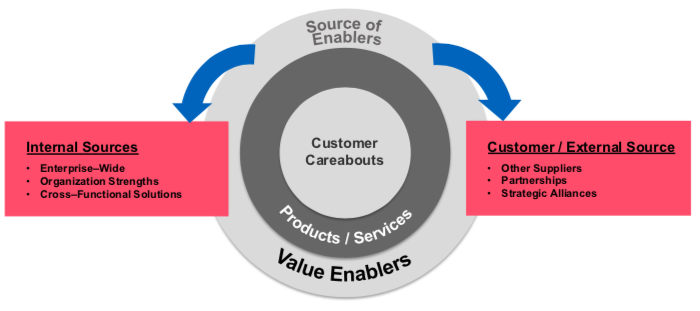
Central to successfully creating joint solutions is the ability of each organization to leverage its enterprise-wide capabilities. Value enablers are defined as any asset, capability, company strength or resource beyond the core product or service offering. While the idea of drawing on relevant cross-business, enterprise resources to co-create solutions with strategic customers sounds logical, fundamental and simple, in our experience it’s not always easy — and not common practice.
For many co-creation initiatives, this is where the “rubber meets the road”: when the joint solutions team engages and requests relevant resources, beyond the product, from across the business. To facilitate access to solution enablers and support their integration into new, “beyond-the-product” offerings, we suggest the following:
- Ensure executive-level support and communication of the “grander why,” i.e., why creating value with strategic. customers is central to your company’s strategy and success
- Engage and align the “critical crowd,” i.e., relevant internal stakeholders — early in the process — well before you make a specific request to invest their time and resources.
- Build a comprehensive list and categorize enabling capabilities around core value themes such as reducing cost, improving efficiencies, growing revenue and elevating the customer experience.
- Identify customer and company gaps in capabilities, i.e., value enablers, that are missing yet critical to co-creating value. Determine if these are capabilities you can build, buy or source from elsewhere.
- Identify and engage “owners” of key value enablers using the customer’s voice to articulate why these capabilities/resources are important, the impact on the customer’s business, the value to the company, the cost of inaction, the joint solutions roadmap and “what matters next.”
- Leverage relevant enablers to co-create solutions using structured brainstorming and creative design thinking to generate concepts and potential solutions.
- Move forward to prototype, test and refine your solution.
Communicate value and drive execution
In this phase, the company and customer:
- Develop their business case and compelling customer value proposition
- Establish and execute their plan to deploy the joint solution/initiative
- Agree on a governance framework, project plan, scorecard and review cadence to drive joint initiatives forward, faster
- Reflect to capture lessons learned, build on what’s working, and assess opportunities to adjust strategy and scale solutions
Quantifying and communicating compelling, differentiating value to key stakeholders within the customer’s organization, and to the customer’s customer, is fundamental and essential to the practice of co-creating value.
Ultimately, if the value of your solution is not recognized, believed in and accounted for, your company will not be able to capture and realize the value co-created in the joint solutions process.
Value propositions are a well-established, yet often poorly practiced, concept in sales and marketing. Through research we’ve established that fewer than 10 percent of customers see their suppliers “creating real value, and being worthy of a long-term strategic relationship.” As one customer commented on their supplier’s value proposition, “This sounds like brochure-speak.”
We need to ask ourselves the question, “Why do value propositions seldom resonate?” Based on our research and work with clients, we’ve established that when compelling value propositions DO resonate, it is because they:
- Focus on what matters most to the customer
- Clearly articulate the differentiating value of your solution compared to the best alternative
- Are quantified in the customer’s currency
- Provide evidence of impact and proof of your company’s ability to deliver

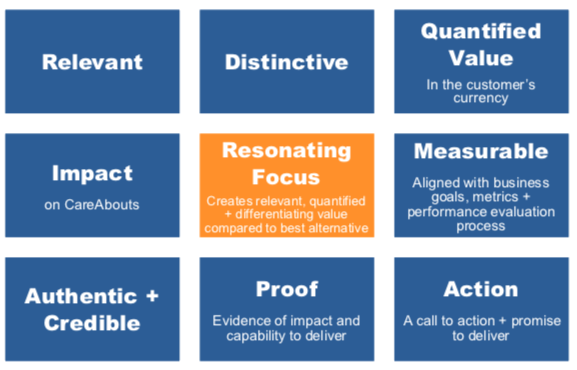
We suggest a simple value creation framework to collaboratively develop your compelling, relevant, quantified and differentiating value propositions. The framework provides a non-prescriptive structure for communicating thought and enables authentic articulation of your joint solution’s impact on the customer’s top “CareAbouts.” This framework, structured around four words — them, us, fit and proof — assures relevance and resonance by aligning what you bring (i.e., your solution) with the customer’s major needs and priorities.
Them: What do they care about? We need to truly understand what our customers care about. What keeps them up at night? What are their key issues and concerns? What is important to them? How are they measured, paid, and rewarded?
Us: What do we have? Here’s where you articulate relevant products, services, and value enablers. What pertinent capabilities and assets can you bring, beyond and/or wrapped around core products and services?
Fit: How does what you have impact what’s important to the customer and customer’s customer? Quantify and describe the impact of your solution on the key issues, concerns and value drivers of your customer and customer’s customer. Articulate your solution’s difference compared to the next best alternative.
Proof: Prove it! Provide the examples and evidence of the value you will bring and demonstrate proof that you can deliver and execute.
Applying this framework guides us to create, articulate and quantify customer-centric value propositions that resonate and enable the company and customer to realize value created through the joint solutions process.
Like what you’ve just read and want learn more? The Summit Group facilitates SAMA Academy’s CORE 2 workshop, “Co-creation and quantification of value.” Click here to learn more about SAMA Academy, to see a list of upcoming workshops and to register.
This is the final installment of a three-part series. Read parts one and two.

